
It's not the Rules of the Road that concern me; it's the Rules of the Street
Foot traffic can be hard to navigate; just like road traffic.

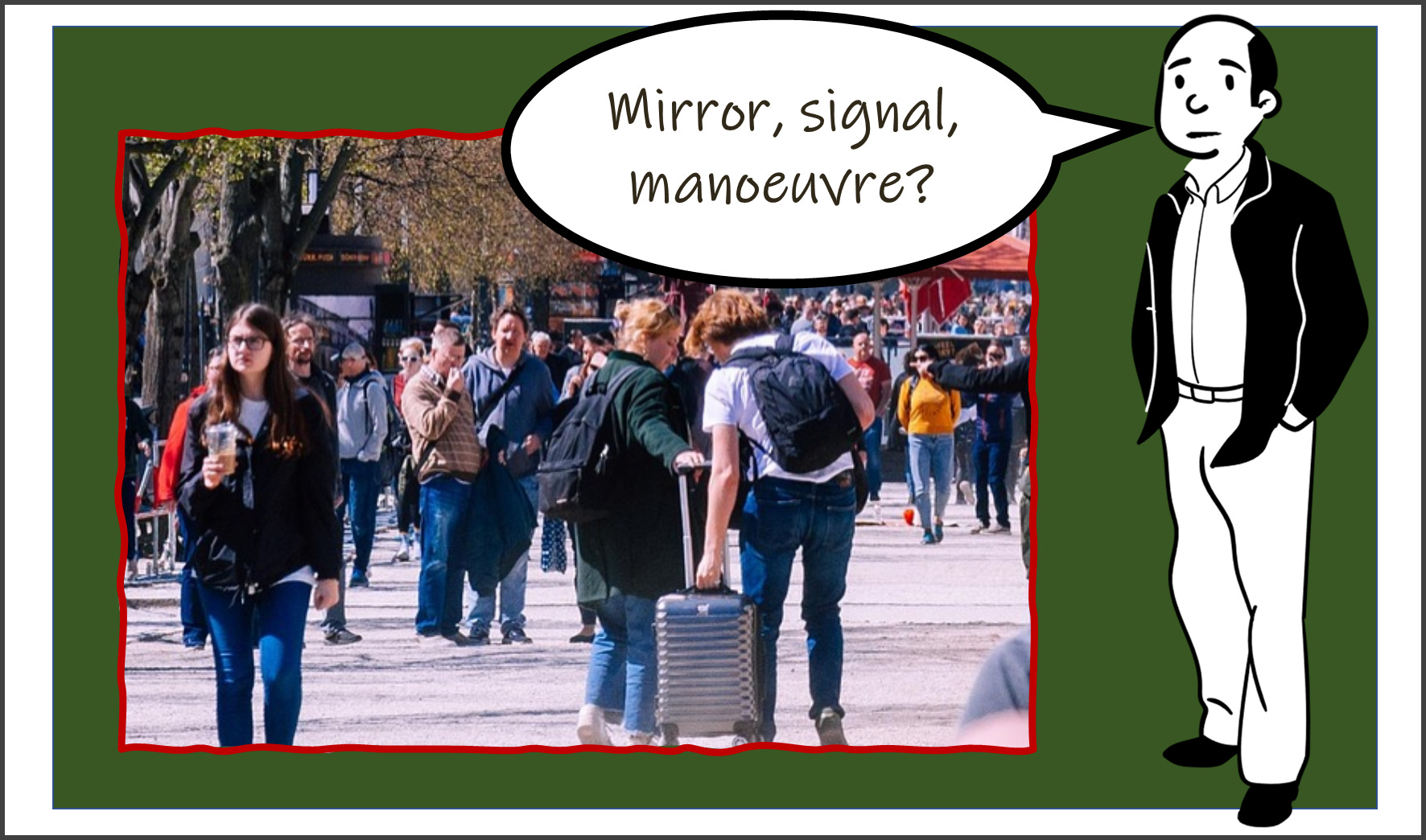
One of my first posts on this platform was a rant about how I have to avoid people who don’t look where they’re going, because they are absorbed by what’s on their phone. ‘Phone Zombies’ I believe they’re called. But as someone who walks into the city centre 4-5 times a week, I can tell you there are many more pedestrian perils that need to be navigated.
Let’s start with the slow walkers. As someone who has a fairly (OK, very) brisk walking pace, I find it desperately frustrating to be stuck behind dawdling pedestrians. Now, I recognize that some people can’t help walking slowly – age, mobility issues, or simply a different natural rhythm – but that doesn’t make it any less maddening when you’re trapped behind them like you’re stuck driving behind a tractor on a country lane.
It’s not a problem when there’s no oncoming pavement traffic; I can check over my shoulder, pull out safely, overtake, pull back in, and continue my journey at my own pace. But when there’s a constant stream of foot traffic coming the other way and I can’t make this manoeuvre, THEN it becomes truly infuriating. Especially when you think it’s clear, pull out, start to accelerate past the human roadblock, only to have to slam on the brakes and pull back in again as a new pedestrian hazard suddenly appears, heading straight toward you.
Even worse are the people who weave as they walk. Completing an overtaking manoeuvre past these meandering souls is doubly treacherous, as they unexpectedly drift left and right in their state of oblivious unawareness. You try to predict their path, but they move like pinballs, bouncing off invisible bumpers only they can see.
This category also includes those who spot something irresistible in a shop window and change direction with all the warning of a drunk driver. One moment they’re ambling straight ahead, the next they’ve performed a sudden ninety-degree turn directly into your path, forcing you to execute a swift evasive manoeuvre that would impress a Formula One driver. My passive-aggressive stare is usually completely wasted on them, as they’re too busy admiring whatever shiny object caught their attention to notice they’ve nearly caused a pedestrian pile-up.
Then there are the people who appear to be talking to themselves – but must have earbuds in, connected to a Bluetooth phone in their pocket. You’re walking along, minding your own business, when one of these individuals suddenly starts having an animated conversation with thin air. I’ve found myself trying to formulate responses on numerous occasions when some complete stranger approaches and says something unexpected, only to realize they’re not talking to me at all, but to someone on the other end of their invisible phone connection.
Talking to yourself used to be considered a sign of madness – now it’s just a sign that you’re Bluetooth connected. The number of times I’ve nearly offered directions to someone having what I thought was a conversation with me, only to discover they’re actually arguing with their insurance company or ordering a takeaway, is frankly embarrassing.
But perhaps most annoying of all are the people who don’t acknowledge you when you move out of their way. There’s a narrow set of stairs with bushes on both sides near my office, where it’s virtually impossible for two people to pass each other simultaneously. So when people are coming the other way, I always stop, pull in, and wait for them to pass. Blame my English public school education, where ‘being a gentleman’ was drummed into us with the same enthusiasm as Latin conjugations.
Just recently, I allowed around five people to get past, standing stock still with my arse pressed into the bushes like I was hiding from enemy snipers. Only one person – a young girl who was the last to come down – actually acknowledged me with a ‘thank you.’ Now I don’t consider myself someone who demands a J.D. Vance level of gratitude, but I do think it’s common courtesy to acknowledge when someone puts themselves out for you. Another thing drummed into us at public school, along with cold showers and the importance of a firm handshake.
The thing is, all these pavement perils pale in comparison to the original Phone Zombies I wrote about. At least slow walkers, weavers, and the chronically ungrateful are paying some attention to their surroundings. The Phone Zombies are in a completely different category – they’re pedestrians operating under the influence of their screens, weaving slowly while talking to invisible people, completely oblivious to everyone around them, and definitely not thanking anyone for getting out of their way.
They’re like a combination of every annoying pavement behaviour rolled into one supremely irritating package. They drift across the pavement like ships without anchors, occasionally stopping dead without warning to stare more intently at their screens, forcing everyone else to navigate around them like they’re broken-down vehicles abandoned in the middle of the road.
Maybe it’s time for a Highway Code for pedestrians. Rule One: look where you’re bloody well going. Rule Two: if someone moves out of your way, say thank you. Rule Three: if you must have a phone conversation while walking, at least make it obvious you’re on the phone so the rest of us don’t think you’re having a psychotic episode.
Until then, I’ll continue my daily obstacle course through the city streets, dodging and weaving past the slow, the oblivious, and the terminally rude, all while maintaining my dignified public-school composure.
Most of the time.
Jonathan is a publisher at Winter & Drew Publishing.
Are you looking to self-publish your book - excited by the high royalties as well as being able to keep your rights and creative control? But… you’re not sure how the process works? Mistakes can be costly and add delays. This is where we can help. Winter & Drew will support you through the process - making it potentially faster and cheaper. Plus you get the credibility of having a publisher for your book.
Check our submission process at Winter & Drew Publishing.
